

Hamstring strain: recovery time and how to get back to running

Hamstring strain recovery typically takes 1 to 6 weeks for a mild strain, 6 to 12 weeks for a moderate one and 12 weeks or more for a severe one, according to University of Portsmouth sports clinicians. Those figures are guides, not deadlines. What actually decides your return date is whether the muscle passes strength and speed tests, because going back to running on a comfortable but under-recovered hamstring is the most common reason one strain becomes two.
A hamstring strain happens when the muscle at the back of the thigh is stretched and loaded at once, most often in fast running, kicking or a sudden change of direction. Fibres are damaged, from microscopic tears to a partial rupture. Rest lets the muscle heal, but not relearn to cope with being lengthened under high force, the job it fails at when you sprint.
If you can walk normally within a day or two, start gentle movement and avoid sprinting and hard stretching. If you cannot, or you notice heavy bruising, a pop at the moment of injury or pain right at the sit bone, book an assessment rather than waiting.
Below: what is happening inside the muscle, a self-check table, a criteria-based return plan, the evidence and red flags.
What happens inside the muscle when a hamstring strains
A hamstring strain is a load failure: the muscle lengthens while contracting hard and the force exceeds what the fibres can take. That is most demanding in the late swing phase of a stride, when the hamstrings slow the lower leg before the foot lands.
The hamstrings are three muscles running from the sit bone to just below the knee, crossing both hip and knee, so a long stride stretches them at both ends at once.
After the injury, the body clears damaged tissue, lays down new fibres and a scar-like repair, then slowly remodels it along the lines of force. Early on that tissue is weaker and less elastic than the muscle around it: it tolerates walking, jogging reasonably and sprinting badly. Hence a leg that feels fine in daily life, a run, and a repair overloaded at a speed it was not ready for.
That is also why the muscle needs progressive loading to recover: tension helps new fibres line up and regain length, whereas complete rest leaves a weak, poorly organised repair, and the Portsmouth team notes that rest alone is usually not enough.
Place yourself: a self-check table before you plan anything
Use this table to judge how quickly to seek an assessment. It is a guide, not a diagnosis.
| What you notice | What it may suggest | Typical recovery window | What to do next |
|---|---|---|---|
| Tight or sore at the back of the thigh, normal walking, mild twinge when you speed up | A mild strain | 1 to 6 weeks | Walk as comfort allows, avoid sprinting, book an assessment if not easing in a few days |
| Sharp pain at the time, a limp for days, bruising after a day or two, pain on stairs | A moderate strain | 6 to 12 weeks | Book an assessment this week so loading starts at the right level |
| A pop or tearing sensation, immediate difficulty walking, heavy bruising, a dip or lump in the muscle | A severe strain or tear | 12 weeks or more | Same-day medical review, then specialist physiotherapy |
The windows come from the Portsmouth clinicians’ rough guide and vary between people.
Criteria, not calendar weeks: the return-to-running checklist
A good plan moves you forward when you pass a test, not when a week ends. The criteria below are typical examples, not a single validated standard.
| Phase | Aim | What it usually involves | Move on when |
|---|---|---|---|
| 1. Settle | Calm pain, restore walking | Short walks, gentle movement, light holds | Walking is normal and pain is low at rest |
| 2. Rebuild | Regain strength and length under load | Bridges, hip hinges, slow eccentric work, core and glute strength | Single-leg strength is close to the other side without pain |
| 3. Run | Reintroduce running in steps | Walk-jog, then steady running, then strides | You can run steadily and do strides with no tightness the next day |
| 4. Sport | Prepare for speed and direction change | Hills, accelerations, sprints, sport drills | Testing is close to the other leg and you cope with a full training week |
The 2010 Journal of Orthopaedic & Sports Physical Therapy guideline commentary by Heiderscheit and colleagues proposed a return-to-sport criterion of less than a 5% bilateral strength deficit, while admitting such thresholds rest largely on expert experience.
Why hamstring strains come back, and the two weeks that matter most
Recurrence is common, and the highest risk sits in the first two weeks back. The JOSPT commentary reports that nearly one third of these injuries recur within the first year.
There are three usual reasons: people return when pain stops rather than when strength and speed tolerance are restored; rehab stops at stretching and skips high-speed lengthening under load; and running volume jumps once the leg feels safe.
To protect yourself in those first two weeks, cap running volume below your pre-injury level, keep hard sprints out until strides feel easy, avoid back-to-back fast days, and drop a session at any new tightness.
What the evidence actually says
The evidence is stronger for prevention than for treating an existing strain, and mixed in places.
- Sherry and Best, 2004, JOSPT. This small trial of 24 athletes compared a programme of trunk stabilisation and progressive agility with a programme of stretching and strengthening. As reported in the 2010 JOSPT commentary, recurrence at one year was 8% with the agility and trunk programme and 70% with stretching and strengthening. The trial is small, so read the figures with caution, but it is why modern rehab includes running drills and trunk control. The original is in JOSPT.
- Heiderscheit and colleagues, 2010, JOSPT. A clinical commentary, not a trial, rated by its own authors as the lowest level of evidence. It proposed a three-phase rehab guide taking about 2 to 6 weeks for grade I and II injuries.
- Van Dyk and colleagues, 2019, British Journal of Sports Medicine. A systematic review and meta-analysis of 15 studies and 8,459 athletes found that programmes including the Nordic hamstring exercise halved hamstring injury rates, as summarised by the Chartered Society of Physiotherapy. That is a prevention finding in healthy athletes, not proof it is the right first step after an injury.
In short, loading the lengthening hamstring, trunk and hip control, and testing before return all have support, but no single protocol is proven best.
Running around Highgate and Hampstead: hills, strides and sessions that catch hamstrings out
Hamstrings are hardest on in fast, long-stride running and on hills where you drive off the back of the leg. Around our Highgate and Hampstead clinics, that describes a lot of normal runs: Highgate Hill, the sloping paths of Hampstead Heath and winter hill repeats.
So we build your return around your route. Flat steady running comes first, then gentle gradients, then strides on the flat, and only then hills and fast repeats. Runners from Crouch End, Muswell Hill and Archway often find the first hill session back is when it tightens, so we ask you to show stride readiness first.
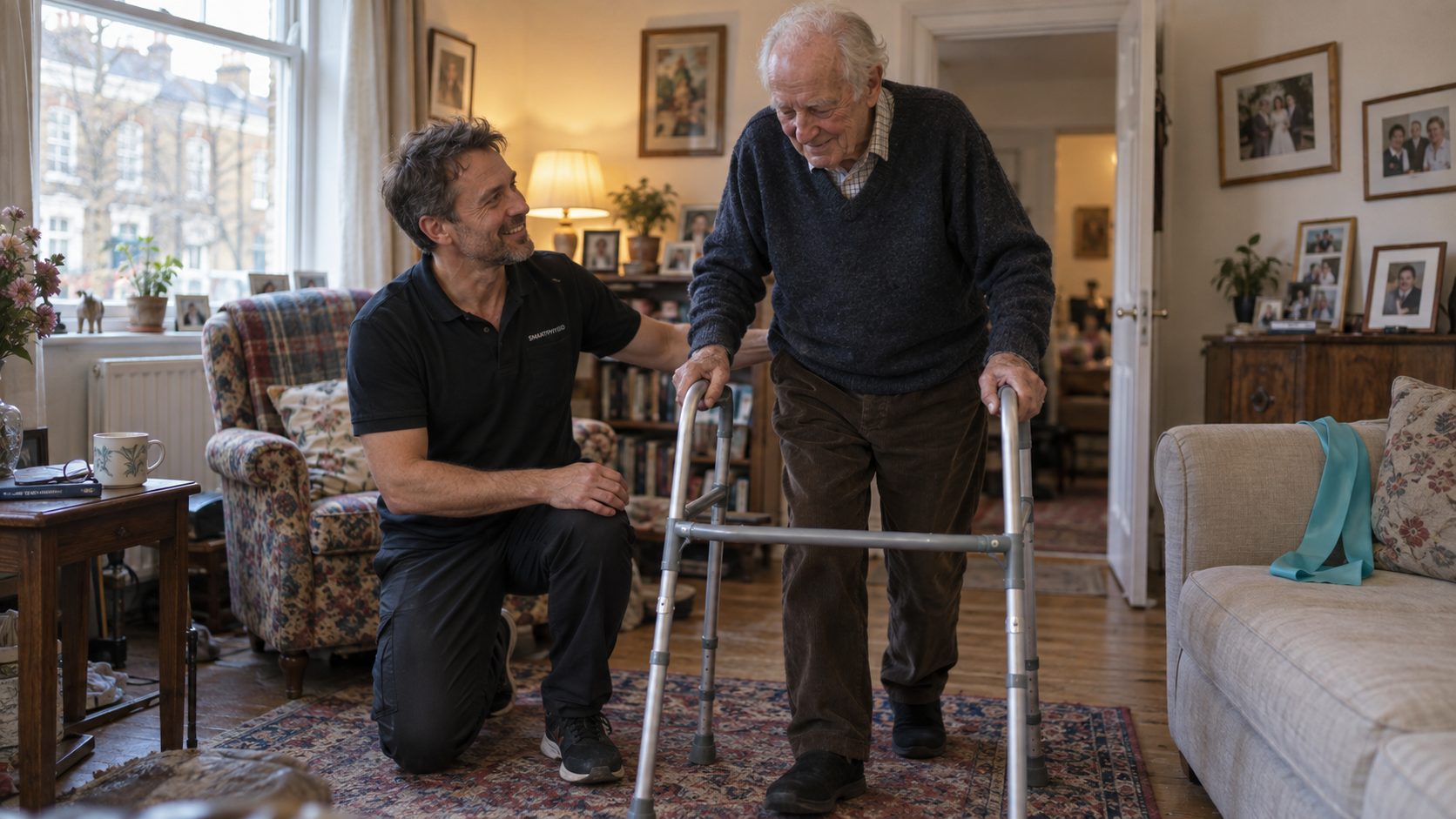
If getting to a clinic is awkward in the first week, our home visit physiotherapy service can start the settling and rebuilding phases at home across London. For how loading beats rest in other tendon injuries, see our post on stubborn Achilles pain, and for what rehab involves, does physiotherapy work.
When to worry: same-day routing
Most hamstring strains are not emergencies, but a few signs are.
- Call 999 or go to A&E immediately if leg pain comes with chest pain or sudden breathlessness, or if you are coughing up blood. These can be signs of a blood clot reaching the lungs.
- Go to A&E or an urgent treatment centre the same day if you cannot put weight through the leg, the calf is swollen, hot and tender, or your foot is numb or weak.
- Call NHS 111 or your GP the same day if you felt a pop and bruising is spreading down the thigh, or the pain is right at the sit bone.
- Book physiotherapy within a few days if you are walking normally but the pain is not easing, or it returns each time you run.
Common questions
Can I keep running with a mild hamstring strain?
Usually not at pace. A mild strain may allow easy walking and gentle loading within days, but sprinting, hills and fast intervals load the injured fibres at their weakest point, a common route to a repeat injury. A physiotherapist can check which loads your leg tolerates and when jogging is reasonable.
Should I stretch a pulled hamstring?
Aggressive stretching in the early days tends to aggravate a fresh strain, because the fibres are already overstretched. Gentle movement within comfortable range is fine. Later, loading the muscle while it lengthens, such as slow eccentric exercises, matters more than static stretching, and your physiotherapist can show you when to start.
How do I know whether it is a strain or something worse?
You cannot reliably tell at home. Sudden pain with a pop, heavy bruising down the back of the thigh, pain right at the sit bone or difficulty walking all need a hands-on assessment. Pain that eases with walking and only twinges when you speed up fits a milder strain, but an assessment confirms it.
Why does my hamstring feel fine walking but twinge when I speed up?
Walking loads the muscle gently, while fast running loads it hard as it lengthens, and a strained hamstring handles the first long before the second. That gap is why feeling fine in daily life is a poor sign of readiness, and why return criteria use strength and speed testing.
Can home visit physiotherapy help with a hamstring strain?
Yes, particularly early on, when the aim is restoring comfortable movement and building base strength. Our physiotherapists can assess and start rehab at home across London. Later phases involving running drills, speed and testing are usually easier in a clinic or on suitable open ground.
About the author
Book your hamstring assessment
If your hamstring is slow to settle, book a clinic appointment at our Highgate or Hampstead clinic. We will assess the strain, set criteria you can track and plan your return around your own routes.

Free guide from Sammy Margo
Keeping Mum or Dad independent at home
Our free guide explains how physiotherapy at home works, whether it's for a parent, a partner or yourself.
- Who it helps, and when to start
- What happens at the first visit
- How to arrange it, and what it costs
More from the SMARTPHYSIO blog


Let's get you moving again
Book a clinic appointment online, or tell us about a home visit and we will call you back the same working day.